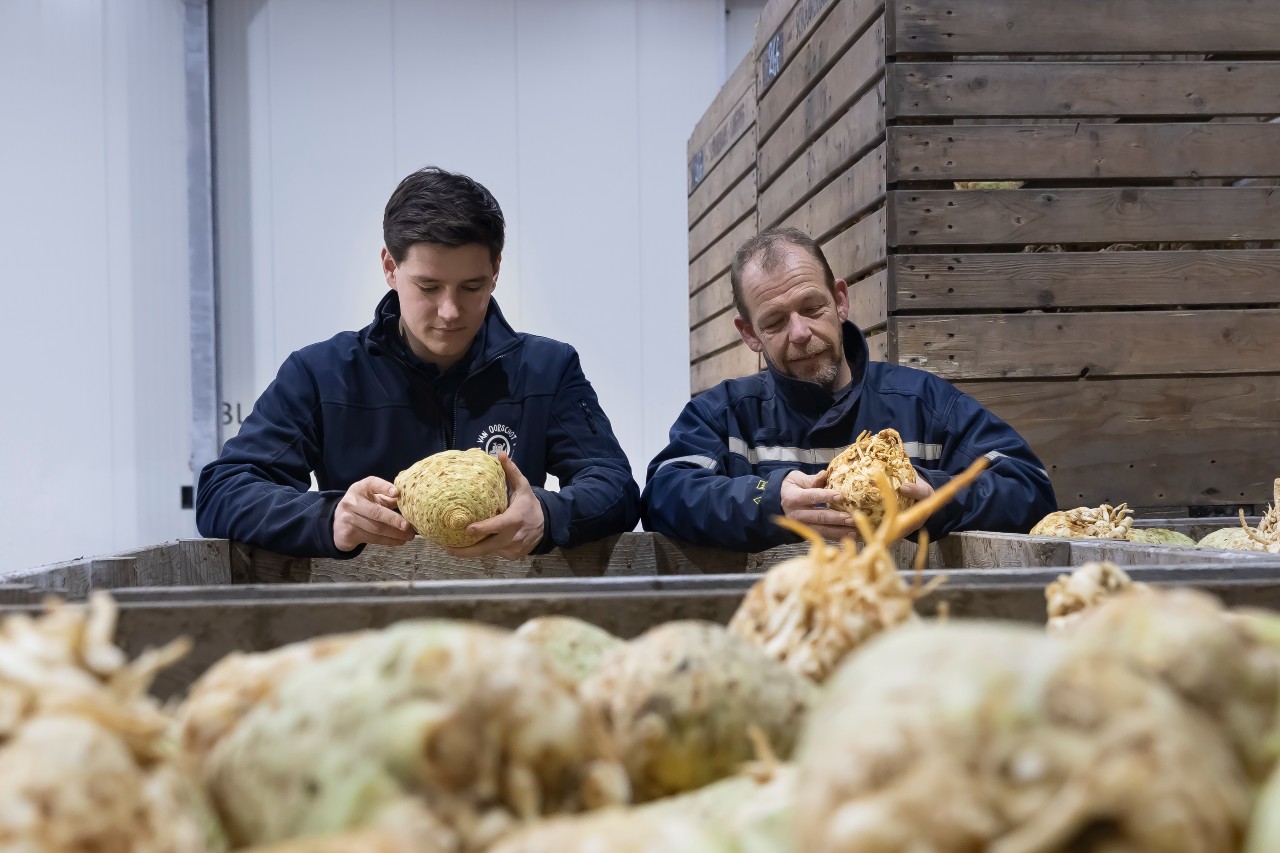


The family-run Kuunders business is active in contract farming, agricultural transport, manure processing, and arable farming. It has several sites, of which the arable farming and storage site in Deurne has now been given a brand-new look. Due to the growing demand for year-round supply, the old storage facility was no longer adequate. “It was still adequate until February, but customers want to be supplied all year round”, says Piet van Gog, co-owner and head of the arable farming division. “That is why we’ve invested in a new storage facility, equipped with modern technology.”


The new 50 by 100-metre warehouse was built in 20 weeks. Timing was crucial to delivering the project on schedule. “To be able to bring in the harvest before 1 October, the roof had to be partially completed before the summer holidays in the construction sector”, explains co-owner Ricus. “That required tight planning, with the construction divided into 3 phases. Equans and the contractor worked together seamlessly and contributed ideas. This enabled us to complete everything on time and commission the new warehouse in the autumn of 2025.”
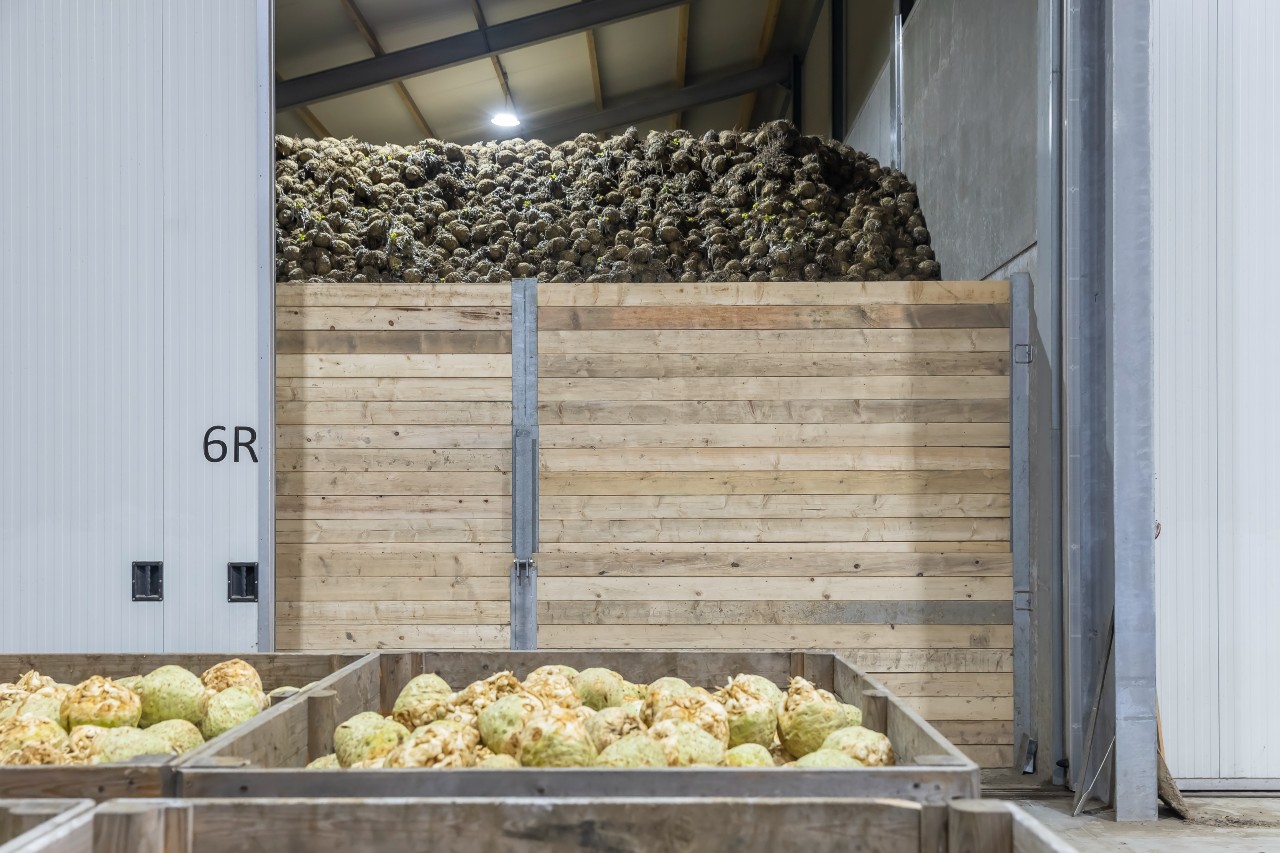
The new storage facility consists of two 2,250-tonne cells for bulk storage, three 800-tonne cells for crate storage, and three cells with a combined capacity of 700 tonnes. Each cell has its own evaporator and climate control system.


Kuunders deliberately opted for a closed storage system without ventilation using outside air. ”The overall package won us over”, Piet says. “With a single drying unit and customised evaporators for each cell, we can store our products much more consistently.” Initially, this closed storage method was met with scepticism. “But after six months’ use, we know for certain: we’ll never build another storage shed with external vents again”, he laughs.
According to Henk Tebben, a storage specialist at Equans and responsible for the design of the installation, the strength lies precisely in the closed system. “With open-air storage, oxygen enters, causing the product to ‘wake up’. In a closed system, we remove CO₂ in a controlled manner and add oxygen in small, measured doses. This keeps the product much more stable and reduces sprouting.”
Ricus sees the benefits every day. “We extract the moisture from the air and remove it as condensation. Contrary to what fellow arable farmers expected, this works extremely well. Even when the produce arrives wetter”, he explains. “After drying, we can cool the produce back down in a controlled manner. The produce remains much more stable, sprouts less and is of much better quality. Customers compliment us on the quality of our potatoes and onions.”
Pockets of rot are also virtually a thing of the past. “The produce remains stable. Affected potatoes do not spread to other potatoes. That brings a huge sense of peace of mind.” According to Henk, this is due to the air being completely separated for each storage cell. “Contamination is ruled out because all storage cells operate independently. With outside air and wind, you can get cross-contamination between products. That simply doesn’t happen here. The even drying process and the monitoring of CO₂ levels ensure that a rotten potato dries from the outside in, and therefore does not release any harmful substances to the surrounding potatoes.”

Storing potatoes with less weight loss and higher yields? Choose our mechanical storage.
Request free brochure
Thanks to digital storage recipes in the control system, Kuunders can easily switch between products. Henk explains: “Most control systems are designed for a single application. But the market is constantly changing. That’s why we’ve opted for a flexible control system that allows Kuunders to adapt and respond quickly.” For each product, there is a storage recipe with pre-set parameters, such as temperature, humidity and air velocity. Are onions being placed in the storage cell just as seed potatoes are being removed? In that case, Kuunders selects the storage recipe for that product, after which the system automatically adjusts the parameters.
According to Ricus, this flexibility is essential. “We are no longer dependent on the weather and can decide for ourselves when to harvest the produce and deliver it when the market demands it. That offers us more sales opportunities. Being able to respond better to supply and demand means greater flexibility and better margins.”
The new system runs remarkably quietly. Henk explains why: “Fans in traditional storage systems can easily reach 110 decibels. Local residents find this particularly disruptive at night. The Kuunders system has no external hatches or pressure wall. We now use internal ventilation via drying units operating at around 80 decibels. As a result, you can barely hear the system from outside.”
The local community has noticed the difference. “Local residents were initially particularly concerned about noise pollution, but are now pleasantly surprised by how quiet the shed is”, says Piet. Furthermore, the odour from the biological sprout inhibitors is barely noticeable. “As no outside air is extracted, we don’t release any odour from the germ inhibitors into the outside environment”, adds Ricus. “And because the agent adheres better to the cells, we need to treat the products with it less frequently.”

When designing the new storage facility, Equans paid close attention to safety and logistics. Kuunders wanted a flat roof to provide extra storage capacity and a more efficient logistics process. Flat roofs were not permitted in the outlying area, so a clever solution was chosen featuring sloping roofs on the outside and a completely flat ceiling on the inside. “Thanks to that flat ceiling, we can stack items to the same height everywhere”, explains Ricus. “That gives us space for around 600 extra crates in this area.”
According to Henk, safety was a key priority right from the initial design stage. “All technical installations, such as pipes, valves and connections, are located on top of the roof. This rules out any risk of leaks into the storage area,” he says. Everything is also safe and easily accessible thanks to logical walkways, secure balustrades and a fixed spiral staircase. “This means we can inspect all the storage cells in a single round without having to bend down or put ourselves in dangerous situations. It’s a real pleasure to work like this”, says Piet with a satisfied smile.
This storage shed is among the best of its kind in terms of energy efficiency. This is not only due to the use of ammonia, a natural and energy-efficient refrigerant, but also to the clever use of energy recovery during condensation drying. “The energy required for drying is used directly to condition the air so that it can absorb moisture from the produce”, explains Henk. “The software measures and controls this with great precision. The heat released can then be utilised in various places. For example, it is possible to heat another storage cell.”
Thanks to this smart energy technology, external heat sources are not required. Furthermore, the system automatically switches between an intensive drying mode and an energy-efficient storage mode. The new system gives Kuunders extra capacity and greater control over quality and logistics. “This method of storage gives us more control and peace of mind in the process, as well as more opportunities in the market”, says Piet. “That is exactly what we need for the future.”


Do you want to control the conditions for drying, heating and storing onions? Then choose condensation drying.
Request free brochureEquans Reference of arable farmer Kuunders
"*" indicates required fields